'A' Explained: How Alignment Is the Hidden Engine of System Intelligence
In most leadership conversations, alignment shows up as a strategic checkbox. Are our people aligned? Is the org aligned with the strategy? Are our goals cascading properly? In the NQ framework, alignment isn’t a soft cultural add-on… it’s a core multiplier of system intelligence.

In fact, it has its own place in the formula:
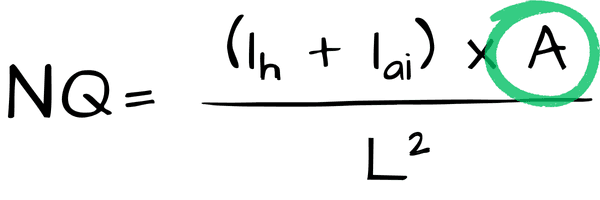
Here, A stands for Alignment. And not in the traditional “are we all saying the same thing?” sense.
Alignment, in this context, is a dynamic measure of coherence. How well individuals, teams, and tools are connected, in sync, and moving with shared intent.
Alignment as Relational Infrastructure
Think of A as the connective tissue of the system. It’s what ensures that the intelligence generated (by humans or AI) doesn’t fragment, distort, or stall as it moves through the organization.
High alignment means:
People understand not just the what, but the why and how of decisions.
Strategic priorities don’t need to be repeated… they’re felt.
AI tools are used consistently and coherently across functions.
Feedback loops are short, clear, and emotionally safe.
The energy in the system flows forward (not sideways or against itself).
In contrast, low alignment shows up as:
Mixed messages from leadership.
Teams pulling in different directions.
Smart people solving the wrong problems.
Tech being used inconsistently or without trust.
Friction, rework, and latency that compounds.
Alignment Is Emotional, Strategic, and Technical
In Quantum Leadership, we view alignment across three dimensions:
Emotional Alignment — Is there trust? Safety? Shared values? Can people bring presence, not just compliance?
Strategic Alignment — Is there clarity on direction? Priorities? Trade-offs? Are we telling the same story?
Operational/Technical Alignment — Are tools, workflows, and data systems speaking the same language?
When these forms of alignment are in place, the system becomes self-correcting. It can sense misfires early. It can absorb shocks without spinning out. It can process complexity without collapsing.
'A' Is Not About Agreement. It’s About Coherence.
One of the biggest myths in leadership is that alignment means consensus. But in high-performing, high-complexity systems, alignment is less about agreement and more about coherence.
It’s the ability to hold tension, difference, and divergence, without fragmentation.
This means your best alignment strategies may involve:
Developing leaders who can host disagreement productively.
Creating shared language, not just shared goals.
Designing rituals that keep priorities visible and energizing.
Your System Can’t Outperform Its Alignment
No matter how high your Iₕ (human insight) or how powerful your Iₐᵢ (artificial lift), if your system lacks alignment, intelligence won’t move cleanly.
You’ll get brilliant ideas that don’t land.
AI tools that generate noise instead of clarity.
Initiatives that stall out at the edges of org silos.
Alignment is the invisible force that determines how much of your intelligence actually arrives where it’s needed. And in time to matter. So next time you’re looking at strategy, performance, or innovation challenges, ask yourself:
Is this really a skill gap? Or a tech gap? Or is it an alignment gap in disguise?
Because 'A' — more than almost any other variable — determines whether your system moves forward… or just spins.
Quick Alignment Check: Are We Really Aligned?
Here’s a short, practical checklist (drawn from the emotional, strategic, and technical dimensions of the NQ model) for leaders to assess the quality of Alignment (A) in their system:
Emotional Alignment
☐ Do people feel safe to express disagreement or uncertainty?
☐ Is there trust across teams — not just within them?
☐ Are values actively lived, not just stated?
Strategic Alignment
☐ Can most people clearly articulate the current strategic priorities — and why they matter?
☐ Do teams understand how their work connects to the whole?
☐ Are we making aligned trade-offs, or just adding more?
Technical/Operational Alignment
☐ Are our tools and systems working together — or creating friction?
☐ Is AI being used consistently and intentionally across teams?
☐ Are data, language, and workflows coherent across functions?
If you answer “no” or “not sure” to several of these, it’s not necessarily a failure. It’s a signal: You might have an intelligence alignment and flow problem, not a strategy problem.