
Moving Beyond Productivity to Measure the Total Intelligence Yield of Human + AI Organisms
The goal of this 'white paper' is to quantify Organizational Intelligence as an engineering challenge, not simply a cultural assessment.
The Systems Quotient* quantifies organizational intelligence (group and individual) in the post-AI era, and moves the concept of 'quantum leadership' from a soft skills philosophy to a hard asset class.
*Let’s refer to Systems Quotient as “NQ” for Network Quotient, which should help minimize confusion with SQ, which already exists in behavioral sciences (often used with Social Quotient or Spiritual Quotient). SQ can be utilized as a supporting variable in the NQ model.
Summary
The "Intelligence Gap" Thesis: We are entering an era where access to intelligence (AI) is infinite and commoditized. With that, competitive advantage no longer comes primarily from having smart people or smart tools; it comes from the velocity and coherence with which a system processes that intelligence.
Problem: Current metrics (Employee Engagement, OKR completion rates, Individual Performance Reviews) measure parts, not the whole. They fail to account for the friction between nodes (human, machine).
Solution: The System Quotient (NQ). A unitary metric that calculates the total output capacity of a Human+AI organism based on Decision Quality, Connection Density, and Execution Velocity.
Evolution of the 'Q' Values
These dates mark when each intelligence became a dominant value-creation force (not when it was conceived or proposed).
Pre-2000 (IQ) Cognitive Intelligence:
Value was created by individual genius and technical mastery.
Early 2000s (SI) Social Intelligence:
Value was created by influence, positioning, and social navigation.
2000s (EQ) Emotional Intelligence:
Value was created by team cohesion and psychological safety.
2010s (AQ) Adaptability Intelligence:
Value is created by adaptability, learning speed, and reinvention.
2020s (SQ) Spiritual Intelligence:
Value is created by meaning, values, and purpose-driven decision making.
Post-2023 (NQ) Systems Intelligence:
Value is created by System Throughput — how effectively a network amplifies intelligence with, and through, AI leverage (est. 2023) without breaking human alignment.
IQ: I can think.
SI: I can navigate. (SI without EQ becomes manipulation.)
EQ: I can care. (EQ without AQ becomes fragility.)
AQ: I can change. (AQ without SQ becomes chaos.)
SQ: I know why. (SQ without IQ becomes fantasy.)
NQ: I can scale. NQ without optimal XQs (IQ, EQ, et al) becomes beautifully efficient acceleration of diminishing returns. Hyper-efficient erosion of value.
The Blind Spot: One can have high IQ + high EQ and still have "Low NQ" as an individual or organization (slow, bureaucratic, risk-averse). NQ captures the motion, not just the potential. Leadership failure is rarely from missing one intelligence. It’s from overusing one while minimizing the others.
The Calculus of NQ
System Quotient (NQ) is defined by the relationship between Intelligence Capacity and System Friction.
The Core Model:
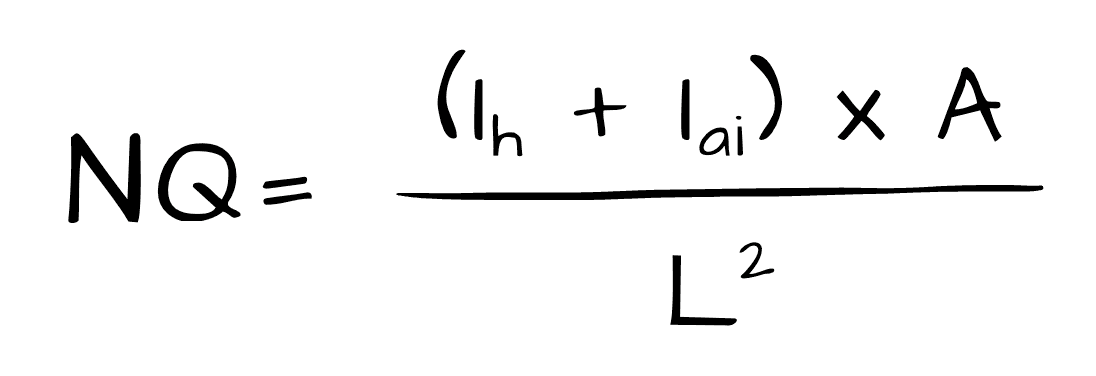
where:
I_h (Human Insight): The individual/collective [X]Q, domain expertise, and creative reasoning.
I_ai (Artificial Lift): The multiplicative factor provided by AI tooling (is the individual or team using AI to move 1x faster or 10x faster?).
A (Alignment/Connectivity): The coherence coefficient (0.0 to 1.0). Are the nodes connected? Is the sentiment positive?
L (Latency): The time gap between Information Arrival and Decision Execution. Note that Latency is squared in the denominator — speed drags are the biggest killer of System Intelligence.
The Three Variables of Quantum Leadership
How to practically measure the model variables using the QL lens:
A. DECIDE (Minimizing L - Latency)
The Metric: Decision-to-Action Time (DtA).
Measurement: How long does a ticket sit in "Review"? How long between a meeting conclusion and the first artifact produced?
The Audit: Calendar analysis vs. Repository commit times.
B. CONNECT (Maximizing A - Alignment)
The Metric: Signal Clarity Score.
Measurement: Low-pass filtering of communication channels. Are goals repeated back correctly? Is sentiment diverging or converging during high-stress sprints?
The Audit: Sentiment analysis on Slack/Teams (anonymized aggregate).
C. AMPLIFY (Maximizing I_{ai} - Artificial Lift)
The Metric: The Leverage Ratio.
Measurement: Ratio of output per human hour. If a task took 10 hours last year and 1 hour this year, I_{ai} has increased by factor 10.
The Audit: Output volume vs. Headcount.
Audit: How to Calculate NQ
A structured assessment pilot. For example:
Week 1: Baseline Mapping. Map the decision nodes. (Who needs to say "yes" for work to move?)
Week 2: Latency Tracing. Measure the average "wait time" in a system.
Week 3: Sentiment Heatmapping. Identify where "Connect" is broken (high friction zones).
Week 4: The NQ Scorecard. A definitive number (e.g., 74/100) benchmarked against a speed benchmark (ex., individual, team, organization, industry, etc.).
Conclusion: The Business Case
The Cost of Low NQ: Calculated as "Intelligence Waste." (Salary spend \times % of time lost to Latency/Misalignment).
The Promise: Quantum Leadership is not training; it is System Optimization. Increasing NQ by X points correlates to [Y]% increase in speed-to-market.
Notes
Measurement Risk: This approach provides a model. Even if the model is debated, the fact that it exists changes the conversation from "feelings" to "variables."
Cognitive Load: It simplifies the complex system into inputs (Human + AI) and outputs (NQ).
Enterprise Readiness: It speaks the language of "Yield," "Latency," and "Throughput."
Authored: December 5th, 2025 by Thomas Stelter
LEADERSHIP IN MOTION
Systems Intelligence & Quantum Leadership
It started with a question: What if leadership isn’t just about individuals — but about how intelligence moves through a system?
In the post-AI era, this insight becomes even more critical. Tools are evolving faster than teams. Intelligence is scaling faster than intention. We’re flooded with potential. And haunted by inertia.
And so, the question I’m asking more and more is: What does it mean to lead a system… not just occupy a role inside one?
A monthly 'Q' note…
Join the leaders and quietly intense thinkers who read my notes about quantum leadership… perspective that might shift perception, practical experiments, and an occasional personal reflection.
Join 1,327,000+ inspired readers of the Q newsletter.
ok, it's more like 100+ but whatever….