Iₐᵢ Explained: The Real Role of AI in System Intelligence
In most organizations, AI is still seen as either a tool to be managed or a threat to be mitigated. But from a Quantum Leadership perspective (one that looks at the intelligence of the whole system) AI is neither a savior nor a risk in isolation. It’s a lift mechanism. A multiplier of throughput. A variable in a system equation. That’s where Iₐᵢ comes in.

In the NQ formula, Iₐᵢ stands for Artificial Lift — the extent to which AI tools are amplifying (or failing to amplify) both the individual’s and the organization’s overall intelligence.
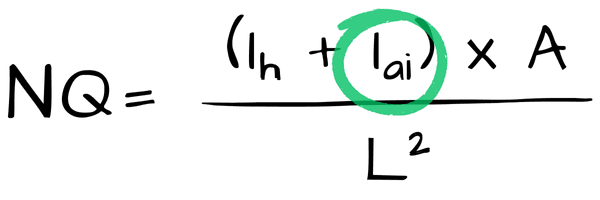
This isn’t just about how well a team automates tasks or speeds up processes. It’s about whether the system at every level is getting smarter, faster, and more coherent because of how AI is being used.
From Tool to Throughput
Most tech adoption conversations ask, “Are we using AI?”
Iₐᵢ reframes that: How much lift is AI actually providing in your system?
Are your teams using AI to move 1x faster, or 10x faster?
Are you leveraging it to deepen insight, or just to reduce headcount?
Is it expanding your system’s capacity to think, sense, and adapt? Or is it adding noise and confusion?
That delta is your Iₐᵢ
And it matters because in the NQ model:
System Intelligence = (Iₕ × Iₐᵢ) × A / L²
Even if you have brilliant people (high Iₕ), your total throughput is capped if AI isn’t lifting their capacity, and if it isn’t informed by that human intelligence in the first place.
The Quality of the Relationship Between Iₕ and Iₐᵢ
Artificial Lift isn’t just a one-way boost from AI to human.
It depends on a loop of mutual understanding between Iₐᵢ and Iₕ — a relational quality that determines whether intelligence is merely accelerated or actually amplified with depth and precision.
High Iₐᵢ requires:
Human insight shaping the use of AI — clear intent, ethical framing, contextual discernment.
AI tools attuned to human values, language, and nuance — not just logic, but meaning.
A dialogue between Iₕ and Iₐᵢ — where each strengthens the other through better questions, better interpretation, and better decisions.
This is especially important in generative and predictive contexts, where AI can mimic confidence but lack alignment with purpose.
When Iₐᵢ is detached from Iₕ, we get speed without sense. Volume without value.
Not just usage. Integration and alignment.
Iₐᵢ isn’t measured by whether AI tools are installed. It’s measured by whether they are meaningfully integrated into how intelligence moves, and whether that movement reflects human clarity, not just machine efficiency.
High Iₐᵢ organizations:
Use AI to enhance, not replace, human interpretation.
Embed AI in workflows that are anchored in shared language and strategic intent.
Develop fluency in communicating with AI, not just prompting it.
The Human Side of Artificial Lift
Ironically, increasing Iₐᵢ is less about technology, and more about how humans show up in relationship with it.
Leaders must help teams:
Understand what they want AI to help them become (not just what to delegate).
Recognize how human blind spots (bias, assumptions, ego) shape AI interactions.
Take responsibility for aligning AI outputs with human integrity and meaning.
That’s the real leverage: AI that not only moves fast, but moves true because it’s working in concert with deeply informed, self-aware human input.
AI is not the strategy. It’s the amplifier.
A high-Iₐᵢ organization doesn’t chase tools. It builds a practice of collaborative intelligence where AI lifts human capacity, and humans deepen the quality of AI’s impact.
It’s not about how much you automate. It’s about how clearly, ethically, and intelligently you align what you make with who you are. That’s the question for leaders now:
Is your AI lifting intelligence, or just velocity? The answer lives in your Iₐᵢ.