'L' Explained: How Latency Is the Silent Killer of System Intelligence
In the era of AI acceleration and constant change, most leaders are focused on speed: how fast we move, how fast we learn, how fast we respond. But in the NQ model, it’s not raw speed that matters — it’s latency. The delay between when a signal is sensed and when meaningful action is taken.

In the era of AI acceleration and constant change, most leaders are focused on speed: how fast we move, how fast we learn, how fast we respond. But in the NQ model, it’s not raw speed that matters. It’s latency. The delay between when a signal is sensed and when meaningful action is taken.
That delay ('L' in the model) might be the most underestimated drag on system performance:
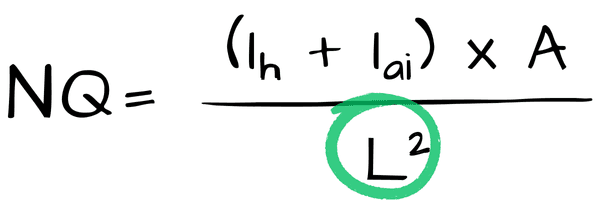
Yes, it’s squared.
Because latency doesn’t just slow things down. It compounds.
It multiplies friction, muddles feedback, and erodes trust. The longer a system waits to act on meaningful insight, the more value (and momentum) it loses.
What Is Latency, Really?
Latency isn’t just a tech term. In organizations, L shows up everywhere:
A front-line employee notices a breakdown… but doesn’t speak up.
A team surfaces a brilliant idea… but approval takes weeks.
Leadership senses misalignment… but avoids the hard conversation.
Every time insight is delayed (by hierarchy, fear, process, or inertia) your system gets slower, not just in time, but in intelligence. And because L is squared, the effect is exponential. A little bit of latency goes a long way in stalling your entire system.
Sources of Latency
In a Quantum Leadership lens, latency isn’t just operational. It’s systemic and human. Common causes include:
Cultural Latency — Fear of speaking up, risk-aversion, perfectionism.
Structural Latency — Bottlenecks, bureaucracy, decision-making by escalation.
Emotional Latency — Unprocessed conflict, avoidance of discomfort.
Cognitive Latency — Overanalysis, unclear priorities, ambiguity paralysis.
Technological Latency — Tools that don’t integrate, fragmented data.
Each of these creates drag. Not just on decisions, but on trust, momentum, and adaptability.
Reducing L = Releasing Intelligence
Leaders often ask, “How do we move faster?” But the better question is: “Where is intelligence getting stuck?” High-latency systems aren’t slow because people aren’t smart or willing. They’re slow because the system makes it hard to act on what’s already known.
Reducing L means designing for:
Shorter feedback loops
Fewer approvals to act
More psychological safety
Faster integration of insight from AI + humans
Clarity on who decides what (and when)
In short: fewer barriers between sensing and action.
L²: The Cost of Delay Is Never Linear
You don’t just lose time when latency is high. You lose energy, confidence, clarity, and often the cost is opportunity. That’s why L is squared in the NQ model. Because delay affects more than outcomes. It affects morale, belief, and the system’s ability to stay coherent.
Want a Smarter System? Start by Lowering the Latency.
Organizations often chase higher Iₐᵢ (AI adoption) or better Iₕ (human capability), but if L stays high, the system intelligence won’t rise.
So if your org is sensing disruption, has strong talent, good tools, yet still isn’t moving, then look at L.
Because the smartest systems aren’t just fast. They’re low-latency. Built to move when the signal arrives.
Quick Latency Check:
Where Are We Slowing Ourselves Down?
Here’s a simple Latency diagnostic… a short checklist to help leaders identify where L (Latency) may be dragging down system intelligence:
Sensing & Communication
☐ Do signals (problems, insights, ideas) flow easily from the edges to decision-makers?
☐ Are people encouraged to speak up early, or do they wait for permission?
☐ Are we regularly missing early indicators because they’re buried in noise or hierarchy?
Decision-Making
☐ Are decisions delayed because of unclear authority or fear of making the wrong call?
☐ How many layers does a meaningful decision need to pass through?
☐ Are teams empowered to act quickly within their scope?
Feedback & Learning
☐ Do we have short feedback loops, or are we waiting weeks to reflect on what worked?
☐ Is there a culture of rapid iteration, or one of cautious over-analysis?
Technology & Tools
☐ Are our AI tools integrated in a way that speeds up insight-to-action?
☐ Are we wasting time reconciling fragmented systems or duplicate data sources?
Relational & Emotional Signals
☐ Are there unspoken tensions slowing things down?
☐ Are difficult conversations being avoided, and decisions postponed as a result?
How you answered may provide indicators around how the intelligence in your systems might be intact… or just stuck in latency.