My journey down the rabbit hole...
It started, as many things do these days, on a Monday. I was staring at an organizational performance spreadsheet. A very sophisticated spreadsheet, meticulously organized, and updated with real-time dashboards. And yet, for all its elegance, nothing was moving. Decisions weren’t being made. People weren’t aligning. Energy was dissipating into meetings, follow-ups, and vaguely anxious Slack threads. And for those using a GPT, I can only imagine what their prompts sounded like. I found myself wondering: Why does everything feel so smart, and yet so… stuck?

That was the doorway. That was the start of my tumble down what I now call the quantum rabbit hole. An exploration into how intelligence actually flows (or doesn’t) through human systems.
And along the way, I stumbled into a series of questions (some surprising, some paradoxical, some downright mysterious) about what we usually call IQ, EQ, SQ, and AQ. In other words: What are we really leading when we lead?
More Than Just Brainpower
Let’s start with the obvious: IQ… the kind of intelligence most orgs still quietly (or loudly) overvalue.
We’ve built teams packed with credentials, experience, and technical brilliance. But IQ alone doesn’t lead to momentum. In fact, if it isn’t coupled with something else, it can actually slow us down… the over-analysis, perfectionism, or the quiet assumption that more thinking is always the answer.
I began to notice that some of the most catalytic moments in a system didn’t come from IQ. They came from something more intuitive. More relational. The moment someone sensed the mood in the room shift and named it. The leader who asked the un-askable question. The teammate who paused the sprint to say, “This doesn’t feel right. Are we solving the right problem?”
That’s EQ and SQ in motion. Emotional intelligence and social intelligence. The ability to tune into signals that aren’t on the slides. The ability to shift course not through analysis, but through presence.
And Then There’s AQ
AQ… Adversity Quotient or Adaptability Quotient, depending on your flavor… is maybe the least flashy and most essential of them all.
I started noticing it not in big crises, but in the micro-moments. The willingness to stay curious under pressure. The choice to repair instead of retreat. The resilience not of the hero, but of the system. Teams that could metabolize uncertainty without losing coherence.
Which brought me to a deeper insight:
Individually, these forms of intelligence matter. But they matter most in relationship. What determines momentum isn’t how much IQ, EQ, SQ, or AQ a team has in theory. It’s how well those intelligences move through the system.
That’s when I started sketching formulas.
Yes, there was actual sketching. On paper. With arrows. :)
The Formula That Changed How I Think About Leadership
Here’s the working version — what I’ve been calling the “systems formula”:
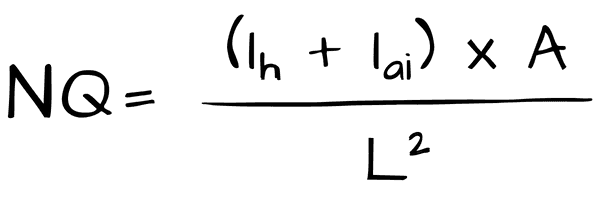
Where:
I_h is Human Insight—the collective wisdom, expertise, and intuition in the system.
I_{ai} is Artificial Lift—how much AI is actually amplifying the work (not just showing up in marketing decks).
A is Alignment—how connected, coherent, and emotionally in-sync the nodes of the system are.
L is Latency—the time between sensing a signal and acting on it. And yes, it’s squared—because speed drag is exponential.
The deeper I went into this formula, the more I realized: This wasn’t just a diagnostic. It was a worldview shift.
Intelligence is a Flow, Not a Trait
Most leadership models still treat intelligence as a fixed asset. Quantum Leadership reframes it as a system-wide flow (at either the individual or group level). It’s not about what any one person knows. It’s about how fast insight can move, how frictionlessly alignment can form, and how quickly action can follow awareness.
That’s where all four quotients come back into play:
IQ helps us understand the problem.
EQ helps us feel what’s not being said.
SQ helps us stay connected and coherent.
AQ helps us adapt and keep going when things shift.
But unless these intelligences can move, they stay locked inside individuals.
Leadership, then, becomes about unblocking the flow. It’s not about being the smartest person in the room. It’s about building the room where intelligence can move the fastest, and the deepest.
Why "NQ"?
The intentional not naming the formula’s outcome "SQ" (System Intelligence), which initially seemed more logical, and instead "NQ"… Network Quotient. Or, Node. Or, n=all.
Why NQ? Because this better captures the distributed, relational nature of what actually makes systems intelligent. It’s not what’s in any one node. It’s what happens between them.
That’s where the magic lives. And sometimes, where the mystery does too.
Down the Rabbit Hole, But Not Alone
This thesis is the result of months of exploration — through hundreds of pages of coaching session notes, experiments with AI, messy diagrams, and real-time team dynamics.
It’s not 'finished thinking'. It’s living thinking. And I’m sharing it because I want to be in conversation about it — with the curious, the skeptical, and the practitioners already sensing these shifts in their own way.
Because if we’re serious about leading in a post-AI world, we need more than better tools. We need a better way to understand the physics of how we lead best.